

























![SNAP HAPPY Recording on a GoPro for social media, senior Sam Mellon has recently started a weekly sports podcast. “[Senior] Brendan Feeney and I have been talking about doing a sports podcast forever. We love talking about sports and we just grabbed [senior] Will Hanas and went along with it,” Mellon said.](https://mhsnews.net/wp-content/uploads/2025/04/sam-892x1200.png)


















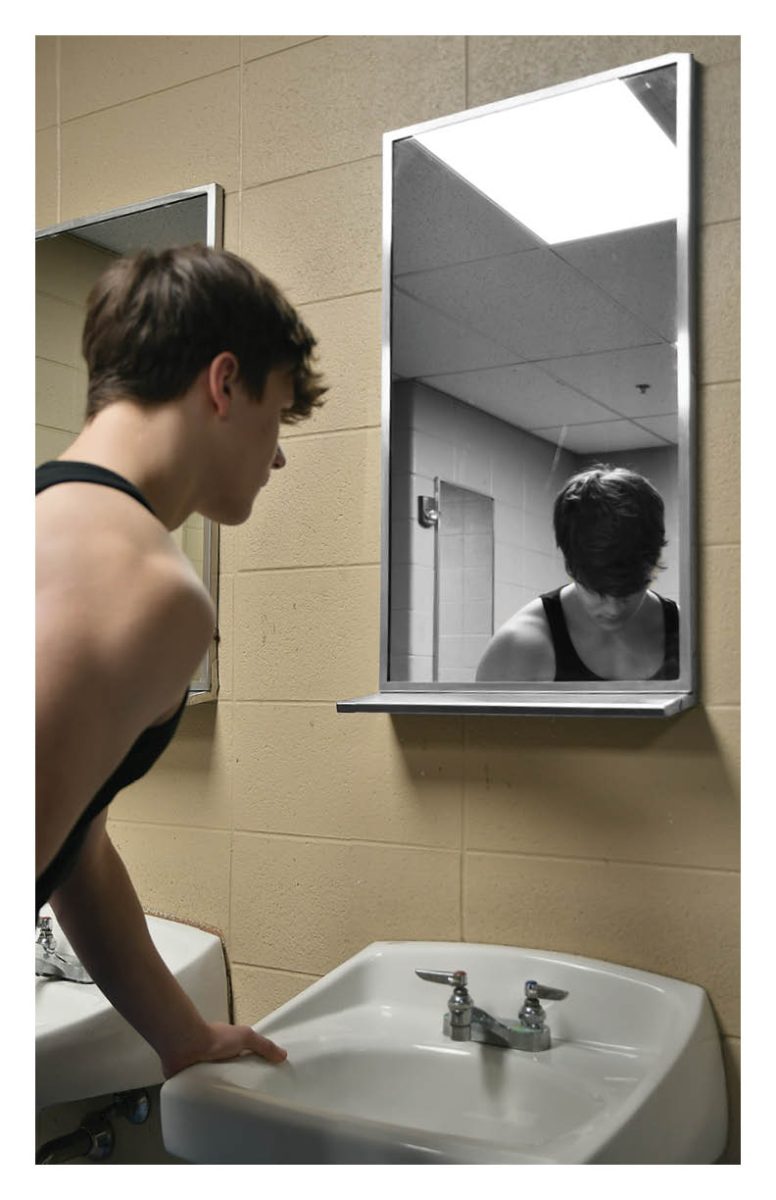
Since the early 2000s, social media has become increasingly relevant, especially among teens. A multitude of platforms are constantly pumping out new trends, products and content which can become invasive to an adolescent’s self-perception.
In a society where breaking beauty standards for women is praised, a similar agenda that is pushed on young men is often overlooked.
“Back when I was younger, I used to watch a lot of workout videos and, dang, I wish I was that size. But, I never really wanted to go to the gym because I was lazy. So, I’ll be watching these guys lift these 45 pound weights and, like, must be nice,” senior Anthony Ward said.
However, caring about one’s appearance is not always as bad as it seems. Working out can support physical well-being and boost self-esteem.
“Once I started noticing, I started to gain more muscle. When the heavier weight started to become lighter, it started to change the way I thought about myself. I thought, wow, this is actually pretty nice,” Ward said.
Many teen males are enrolled in strength and conditioning class as it is a supplement to taking PE class. The weights program is also a requirement for all student-athletes, which is rare amongst schools in NWI. Being health-conscious and encouraged by the school is beneficial; however, at what point do overambitious goals fuel obsessive behaviors?
Strength and condition teacher Riley Edgerton has noticed an outward change in his classes.
“There has been a noticeable shift in how many students’ approach strength and conditioning,” Edgerton said. “While performance and athletic development remain a primary motivation for a large portion of our students, we are also seeing a small number of students who are influenced by appearance-based goals, often shaped by social media and popular fitness culture.”
The current youth is bombarded by ever-changing beauty standards flaunted over a variety of media platforms, all a click away. Apps like Instagram, TikTok and X (formally known as Twitter) expose teen boys to unrealistic, flawless standards set by toxic influencers. These distorted versions of reality put pressure on young men and may cause them to feel obligated to achieve these sometimes impossible goals.
Alongside this, new insecurities are made up everyday, such as a sharp, masculine jawline, negative canthal tilt or low-set eyebrows. Trends like looksmaxxing and bonesmashing, which are often treated as a joke, are extremely harmful towards teens today. These practices promote treating a person’s outward appearance as their entire self-worth.
“They think that the only way that they need to get fit is to chase after monster trucks and drown their face in water. That’s just their influence,” Ward said.
What is seen on-screen isn’t always the truth. Overall well-being and longevity is important towards building a physique.
“Our goal is to create a culture where students value effort, accountability and well-being just as much as results,” Edgerton said. “We train student-athletes, not TikTok influencers, bodybuilders or social media gurus.”
This issue, like most, cannot be resolved in a single day. The motivation is pressed on adolescence by outside forces, but resolution starts with oneself. The only way to steer away from critical comparison is to shift one’s thinking and mindset rather than attempting to change an entire toxic environment.